R. A. Markus, Saeculum VI — Coge Intrare

We have now summarized chapters one, two, threefour, and five of Robert A. Markus’ Saeculum.

We turn now to chapter six — not the final chapter of the book (there is one more, and several appendices), but the final one dealing with purely historical matters, and the last we shall cover for the foreseeable future.

Continue reading

R. A. Markus, Saeculum V — Afer Scribens Afris

We have now summarized chapters one, two, three and four of Robert A. Markus’ Saeculum.

We turn now to chapter five.

Continue reading

R. A. Markus, Saeculum I — History: Sacred and Secular

Robert A. Markus died of cancer in 2010, at the age of 86. Together with Peter Brown (who cites Markus often in his own works, and contributed the Epilogue to Markus’ Festschrift), Markus was responsible for fleshing-out the territory of the study of Late Antiquity — generously speaking, between Imperial Rome in the third century A.D. and Charlemagne.

Of Romanian Jewish parents (who left Romania in 1939, settling eventually in England), yet later a convert to Catholicism, Markus studied medieval philosophy at Manchester University together with figures like Alasdair MacIntyre, had a stint as a Dominican, and then settled down to marry. He taught at Liverpool, then at Nottingham, taking early (though quite active) retirement.

Saeculum: History and Society in the Theology of St. Augustine, Revised Edition (New York: Cambridge, 2007) was his first significant book (a helpful list of Markus’ publications can be found here). Originally published in 1970, it was eventually revised for a second edition. Markus’ thesis in Saeculum is only slightly slippery: whether we claim (with Thomas M. Parker) that its center is found in “Augustine’s conception of the relation between sacred and secular history”, or in “Augustine’s secularization of political institutions” and his “views on the nature and purpose of human society” (John Dillon), we still come very close to the heart of the book. (The subtitle “History and Society” should suggest as much, since the pair is related, but not totally unified.) In a manner, these senses may be reconciled in Gerard A. Reed’s review, where the book’s heart is to be found in “Augustine consider[ing] [that] Christian society [is] eschatological rather than terrestrial, rejecting any socio-political notions which denied the non-temporal, trans-historical dimensions of his City of God”, though, despite this eschatological acknowledgement, the crux of the book is in the way that Augustine secularized conceptions of history, society (including the “state”), and the Church, by evaluating them all through this-worldly terms and/or ends. The chapters that follow flesh this out. Continue reading

Excerpt #2 — Larry Shiner on Friedrich Gogarten on Secularism

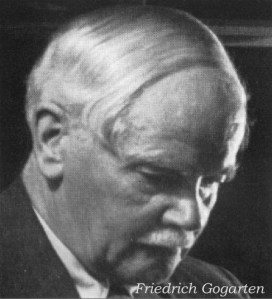
Here is the beginning of Larry Shiner’s book on Friedrich Gogarten, a German Lutheran friedrich gogartenwho wrote during the beginning of the 20th century. I found Gogarten through a footnote in a book by another German Lutheran, Wolfhart Pannenberg, and looking at this, it is difficult to hear that Gogarten differs from Pannenberg on this topic, whether due to the historical record or to the influence Gogarten had on Pannenberg (whose take on secularity and secularization shall eventually appear here).

Gogarten’s general thesis strongly resembles elements of the disenchantment of the modern world that Charles Taylor describes. Although disenchantment is not quite the same thing as the de-divinized world that the early Christians or their successors lived in, the two are related, and the latter certainly offered part of the foundation for the former. Also similar to the above-linked post on disenchantment is the model of meaning found in Gogarten, who argues, according to Shiner, that man

universally experiences responsibility for his own destiny as the task set by his relation to the world. However feebly we may live up to it, Gogarten sees in this responsibility the Law before which we must justify ourselves today, the ultimate “ought” written into the fabric of existence.

Although the pre-Christian world can fairly be described as presenting “a mythically understood cosmos determining and securing human life by its spiritual powers”, I am uncertain as to whether the pre-Christian engagement with the world neglected to think of the world as over-against humanity. Certainly the divinity of each and all things in The Iliad militates against this? –but then this could be taken to signal that the world is not other than the subject.

If the reader discerns me to have serious reservations about this excerpt, in whole and in part, he or she would be correct. It has value insofar as it presents one take –one take– on secularization as the actualization of Christian principles. (There are other interpretations that see modernity as such an actualization, and still other takes that see the secular modern period as something autonomous, and legitimate in itself.) Enough: here is Shiner on Gogarten. Continue reading

Peter Brown on Christianization, Part III: “Tempora Christiana”

The previous post covered another essay by Peter Brown on the modern narrative of the Christianization of the fourth and fifth centuries that we have inherited. There, Brown was replying to Ramsay MacMullen. In our modern narrative, MacMullen writes, any alleged process of Christianization ought to show “Christians not just talking but doing; and it must show them in some opposition to evidently accepted standards” [“What Difference did Christianity Make?”, Historia, 35 (1986), 324]. That is, there must be widespread socio-moral (and legal) change, or there is no manifest Christianization.

In the first essay of Authority and the Sacred that we earlier summarized, Brown notes three areas in which the Roman world did begin to change under the influence of Christianity, though “with the slowness of a glacier” [Authority and the Sacred: Aspects of the Christianisation of the Roman World (New York: Cambridge, 1997), 9]. The third of the three areas of Christianization concerned the heritage of the past as the inheritance of pagan habits to be overcome by Christian habits.

This is what concerns us here, the idea that history and a heritage can be divided into chronological epochs with their own moral worlds. I mentioned in a somewhat-recent post about how people began to divide time based on the birth of Jesus in the sixth century. There are roots in the fourth century for dividing history this way. After the sack of Rome in A.D. 410, pagans began to speak disapprovingly of the times in which they lived as “Tempora Christiana“, “Christian Times”, by which

they meant, not the stability of the Constantinian order, but a new age, overshadowed by a crisis of authority which led to renewed barbarian raids throughout the Roman provinces of the West. [Peter Brown, The Rise of Western Christendom: Triumph and Diversity, A.D. 200-1000, Tenth Anniversary Revised Edition (Malden, MA: Blackwell, 2013), 86]

Christians in the late fourth century thought that the times had changed. The Apostolic period had passed. This was a new era. The empire was now conceived of as an instrument of divine providence, as part of sacred history that would advance the purposes of God in the world, and this lead to a sense that, in this era, things were both permissible and prescribed that were not before. Christianization had ushered in a new age in sacred history. What is the trajectory that enables this to be possible, and which made this a problem for those who lived through this period of alleged Christianization? (We will look more closely at this in the coming weeks, as we cover R.A. Markus’ Saeculum: History and Society in the Theology of St. Augustine, but what does Brown give us as a background in chapters two and three of The Rise of Western Christendom?)

Continue reading