Merit & Grace in the Late Medieval and Early Modern Period, Part 2


Continued from the previous post Continue reading

Merit & Grace in the Late Medieval and Early Modern Period, Part 1

1) There are a number of helpful topics by which one might examine some of the differences and similarities across the centuries from the Medieval period up through the Reformation, and each allows a set of concerns to come into focus. The related questions of the nature of grace and whether a person might merit salvation is one such helpful pair of topics. These questions, conjoined from the Middle Ages through the beginning of the Reformation, begin at a point where they are very much tied up with ontological questions about the relationship between beings and God, and about the character of knowledge, in general, and the nature of theological knowledge, in particular. Do beings naturally participate in God to some degree (i.e., in a manner according to the nature of a being), or are they wholly separate, radically contingent and entirely superfluous ephemera of the divine will, thoroughly alien in their being to divinity, without a native point of contact? Is knowledge –even secular knowledge– a participation in divine knowledge, or is it a navigation of singularly unique particulars through signs? Is grace participation in God, likeness to God, favor from God, divine acception, or else some or even all of these? Is this grace something which people are able to know they are partaking of? The Nominalists’ and Reformers’ answers to these questions illumine some of the crucial elements that come to characterize the Modern period, our secular cultural condition. We will begin with Thomas Aquinas (1225–1274), briefly noting the Ockhamist/Nominalist tradition which follows shortly after him, then we will move through these questions in Martin Luther (1483–1546).

Continue reading

An Example of Historical Distance & Difference: Χάρις, Linguistic Singularity, and Confessional Projection

Translators are confronted with numerous choices when rendering ancient Greek words into English, and one of these is how to bridge the distance between the world of the text and the world of the reader.  This historical distance can be notoriously difficult to see when one engages with a text that has already been translated, and which arrives in the world of the innocent reader as pre-chewed food. (A recent post on the shift in words we translate as “happy” reminded me of the need to write something on this more specifically.) This highlights a central feature of the secularity of our modern world: historical distance, the autonomy of historical epochs and local worlds, and the seeming worldliness of every bridge or road we might build to traverse them. Continue reading

Excerpt #2 — Larry Shiner on Friedrich Gogarten on Secularism

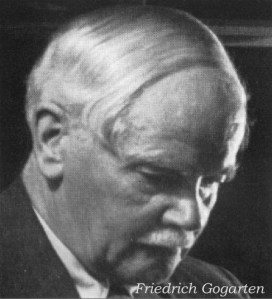
Here is the beginning of Larry Shiner’s book on Friedrich Gogarten, a German Lutheran friedrich gogartenwho wrote during the beginning of the 20th century. I found Gogarten through a footnote in a book by another German Lutheran, Wolfhart Pannenberg, and looking at this, it is difficult to hear that Gogarten differs from Pannenberg on this topic, whether due to the historical record or to the influence Gogarten had on Pannenberg (whose take on secularity and secularization shall eventually appear here).

Gogarten’s general thesis strongly resembles elements of the disenchantment of the modern world that Charles Taylor describes. Although disenchantment is not quite the same thing as the de-divinized world that the early Christians or their successors lived in, the two are related, and the latter certainly offered part of the foundation for the former. Also similar to the above-linked post on disenchantment is the model of meaning found in Gogarten, who argues, according to Shiner, that man

universally experiences responsibility for his own destiny as the task set by his relation to the world. However feebly we may live up to it, Gogarten sees in this responsibility the Law before which we must justify ourselves today, the ultimate “ought” written into the fabric of existence.

Although the pre-Christian world can fairly be described as presenting “a mythically understood cosmos determining and securing human life by its spiritual powers”, I am uncertain as to whether the pre-Christian engagement with the world neglected to think of the world as over-against humanity. Certainly the divinity of each and all things in The Iliad militates against this? –but then this could be taken to signal that the world is not other than the subject.

If the reader discerns me to have serious reservations about this excerpt, in whole and in part, he or she would be correct. It has value insofar as it presents one take –one take– on secularization as the actualization of Christian principles. (There are other interpretations that see modernity as such an actualization, and still other takes that see the secular modern period as something autonomous, and legitimate in itself.) Enough: here is Shiner on Gogarten. Continue reading

A Preliminary Synopsis of the Life of Thomas Müntzer (Occasionally Updated)

It has become a truism that history is written by the victors, and the case of Thomas Müntzer (died 1525) would not falsify this. During and after his lifetime he had acquired such high-caliber opponents as the iconic religious reformer Martin Luther, to say nothing of the secular princes of Saxony. Müntzer (also spelled Münzer, or Müncer, or even other ways, meaning “miner”) was thus largely remembered through the eyes of his opponents, until his literary remains were rediscovered in the 19th century. These remains cover a limited stretch of his life, however: his “extant, authentic writings and correspondence from the scant ten years between 1516 and 1525, along with scattered reports about him, are not sufficient sources for writing a genuine biography.” [Seebass, 338[1]] Indeed, “Little can be told with certainty about Müntzer before 1517”. [Gritsch, 1[2]]

Müntzer Medaille 1976

An East German coin

This uncertainty has not prevented various factions from advancing their claims for or against him, however. Frederick Engels and Marxist historians have claimed him as a forerunner of revolution, championing the working class against the oppression of the landlords (he became a hero in East Germany‘s Socialist national narrative). Martin Luther and Lutheran historians have despised him as a rebel and revolutionary, because of his role in the German Peasant’s War above all, and a fanatic, because of his propounding the necessity of a mystical and activist spirituality which required spiritual purification through suffering and divine abandonment, for which a special illumination distinct from the biblical text was required — as opposed to the sufficiency of a trusting response to the divine promise in the divine Word as it was set forth in proper preaching and rites of worship, per Martin Luther and the Wittenberg reformers (Müntzer thought that the text of the Bible was dead “Babel” without this illumination and transformation through the Spirit, just as Calvin would in a few short years say that the Bible was not the Word by the act of preaching and the rites of worship, as Luther taught, but was a deposit of divine teaching, requiring the additional illumination of the Spirit to properly interpret it). Anabaptists and other contemporary groups stemming from the so-called Radical wing of the Reformation have a conflicted stance toward him, disapproving of his use of the sword, while looking favorably upon many elements of his theology and spirituality, especially his emphasis on a faith that bears fruit in deeds and on the separation of the chosen people of God from “the world.” (Most current works on him attempt to temper or remove any ideological excesses of previous scholarship, even if they incline one way or another.)

Another East German coin, marking what was presumed to be the 500th anniversary of Müntzer's birth.

Another East German coin, marking what was presumed to be the 500th anniversary of Müntzer’s birth.

Psychologically, it is very easy to drape upon his words and deeds the most noble or else the basest motives, making chastity of psychological conjecture important for lack of certainty. As a final flourish of uncertainty, we don’t even know what he looked like — the earliest portrait of him was made long after his execution (not that a portrait would be an enormous help in reconstructing his life and motives). Yet despite the lack of certainty on nearly every level, we can say from what we do know that his life was at least iconic for many threads of the modern world, as the war over his legacy illustrates.

Continue reading