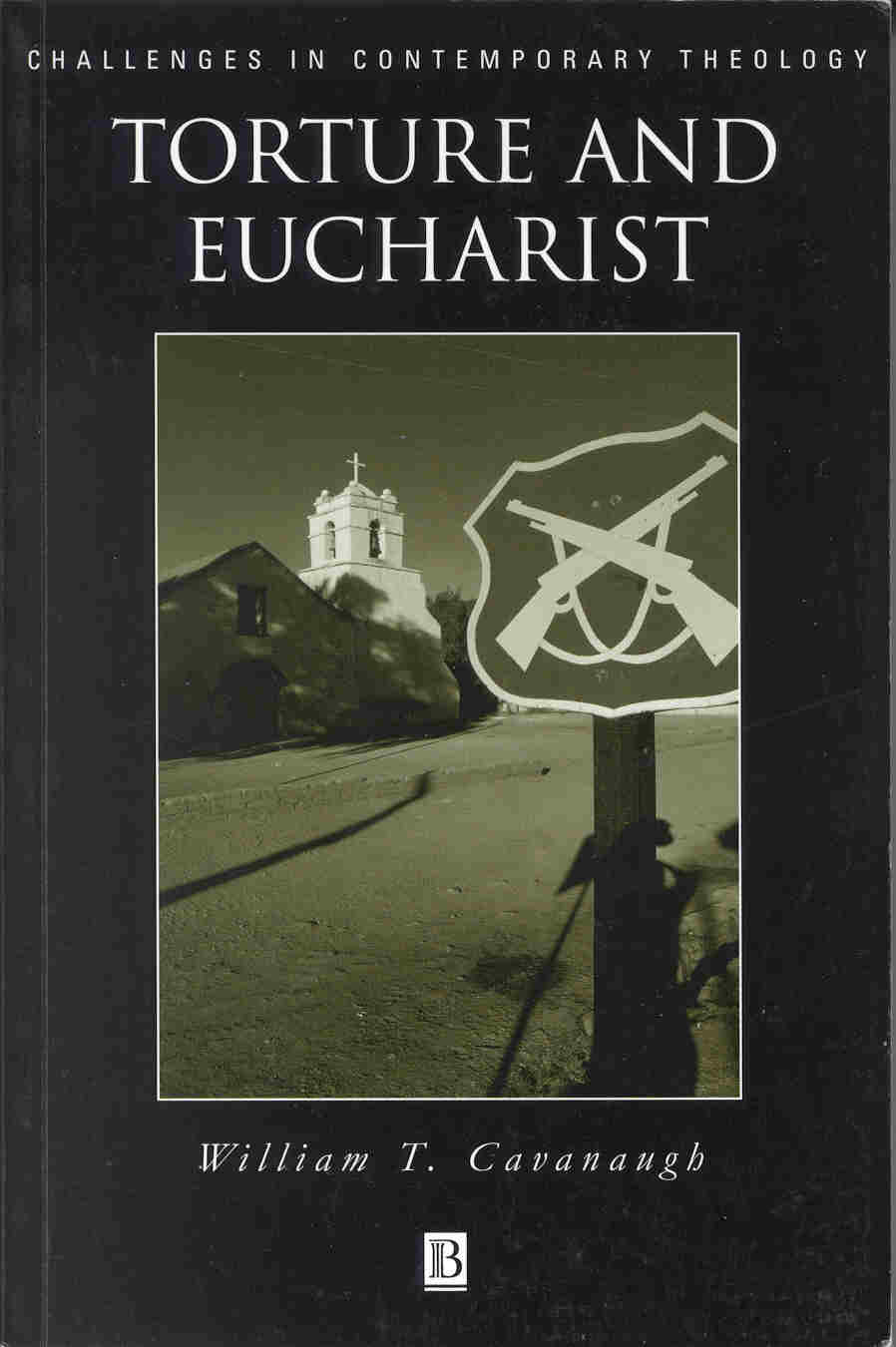
William T. Cavanaugh’s Torture and Eucharist

william t cavanaugh -- torture and eucharist 1

$40 for a paperback often feels more like torture than the Eucharist, but not this time.

William Cavanaugh is currently Professor of Catholic Studies at DePaul University. He completed his BA (Theology) at Notre Dame, received both a second BA in Theology and Religious Studies at Cambridge University as well as an MA from the same, and finished his Ph.D. (Religion) at Duke University, under Stanley Hauerwas. Together with Hauerwas, he is associated with the Ekklesia Project [1] (under whose aegis he is an editor for two book series). The Ekklesia Project is a confederation of Trinitarian Christian communities, including both Catholics and Protestants, who see allegiance to the Kingdom of God as fundamental for Christians, and as exercising a critical function on what other kinds of allegiances and affiliations a parish and an individual Christian should have. This includes commitments that might suggest that inflicting violence is compatible with Christian discipleship (simply speaking: this project claims they aren’t). [2]

Cavanaugh is also connected to the Radical Orthodoxy movement most often associated with John Milbank [3] (who is mentioned several times in Cavanaugh’s Torture and Eucharist). Radical Orthodoxy is known for its attempts to critique modernity’s “pre-theological” categories, to reaffirm theology –and not any secular discourse– as the foundation and true basis and description of the Church’s vision and ecclesial practices, and reinstitute theology as the queen of the sciences (this concern to veto the total reduction of the Church to sociological analysis is articulated explicitly in several spots in Torture and Eucharist [4]).

Cavanaugh writes and lectures on a wide range of topics, some on the Christian tradition but mostly within the umbrella of political theology – the intersection of politics and religion, the rise of the nation-state, the legitimacy and genealogy of “religion” as a category, the nature of torture, &c[5] There is an understanding of the modern nation-state as atomizing and intrinsically violent (even “founded on violence” [6]) in the background of Cavanaugh’s work, as founded upon a false myth of violence. [7] To varying degrees, these topics are all touched upon in Torture and Eucharist.

For seventeen months, from July 1988 to December 1989 [8], Cavanaugh “lived in a slum area of Santiago Chile during the military regime,” and “knew people there who had been tortured”. [9] He returned afterwards to Notre Dame as a Research Fellow for six months in 1990, to develop “a computer data base for researching human rights abuses using the microfilmed archives of the Vicariate of Solidarity”. [10] After this experience, it became a focus for his subsequent Ph.D. work. Cavanaugh returned to Chile in 1993 to conduct further research. [11] Torture and Eucharist is based on his doctoral dissertation. [12]

In Torture and Eucharist, Cavanaugh describes and analyzes the horrendous effects of silent abduction (being “disappeared”) and especially torture as a strategy employed by modern nation-states to dissolve the various social bodies that individuals are embedded within. Once citizens are torn away from these larger bodies, the state gains direct and unmediated access to each and all of its own, without the possibility of encountering resistance to its authority or facing the alternative claims of any rival. In Torture, Cavanaugh looks at this dynamic as it was in play in Chile during the Pinochet regime from 1973-1990.
Continue reading

Charles Taylor on Disenchantment

As perhaps the world’s premier scholar on the character of Secularism, Charles Taylor shouldn’t need an introduction. If the reader is unfamiliar with him, however, he or she should simply accept that Taylor has had a remarkable career. Following the publication of his landmark book A Secular Age, Harvard’s Belknap Press published a volume of Taylor’s essays related to the themes he earlier explored in Secular Age; the work is titled Dilemmas and Connections: Selected Essays.

Below is an abbreviated version of one of his essays from Dilemmas, titled “Disenchantment-Reenchantment” (it is Chapter 12 of Dilemmas); the bracketed numbers [xxx] indicate a page number in the original English-language hardback release. Taylor’s essay is 15 pages or so, and of course has more meat. Currently, I’ve only reduced it to about 1/4 of its original size. I plan to post more such abbreviations.

Possibly, the general thrust of Taylor’s argument may be found in the final words of the summary, below: “Despite the widespread loss of the magical world and of the metaphysics of the Great Chain of Being –even despite the widespread loss of belief in God– a strong evaluation of meaning is still possible in the modern world, even if it is a world painted by a reductive and mechanistic science, so long as this reductive language doesn’t swallow the self-perceived integrity of the evaluating agent, so that it cannot be said to truly evaluate the wonder of the world and be so motivated, by this evaluation, to respond in love.”

* Continue reading

Machines for Eating and Humans for Feeding

Or: What I Learned from Working at Dunkin’ Donuts.

The view from the bottom is really quite spectacular, but those who have always lived there rarely see clearly. They’re not stupid –they know roughly where they are– but they’re  trapped by so many tethers they find elusive, and they have no map for how to get out. The rest of us cannot see the truth about ourselves until we have dealt with the truth about them. I worked with them for two months. In immediate hindsight, here are six observations:

1: “Minimum Wage” really means that your employers would likely pay you less, but that they can’t legally get away with it.

This gives a whole new meaning to the phrase, “human resources.” Resources: like oil or coal. When people are paid only enough money to fund some small entertainments, or to pay their cell phone bill, then what does that say about the way that their employer values them? –as better coal, or as worse coal, but always as coal. This demotivates. One is sensitive to this, even if one is not aware of it.

It’s true that good help is hard to find; it’s also true that good help is impossible to retain or appropriately incentivize on what is approximately an $8.50/hr. minimum wage: employees become as disposable as the coffee filters, and care about their job as much.

Of course, these jobs are not designed as career jobs, and high turnover is expected, so a critical reader may waive this all away as so much whiny cavaliering. Employees are seen as deluded for trying to turn a temp gig into a permanent one.

Continue reading

Richard Crouter’s Friedrich Schleiermacher: Between Enlightenment and Romanticism

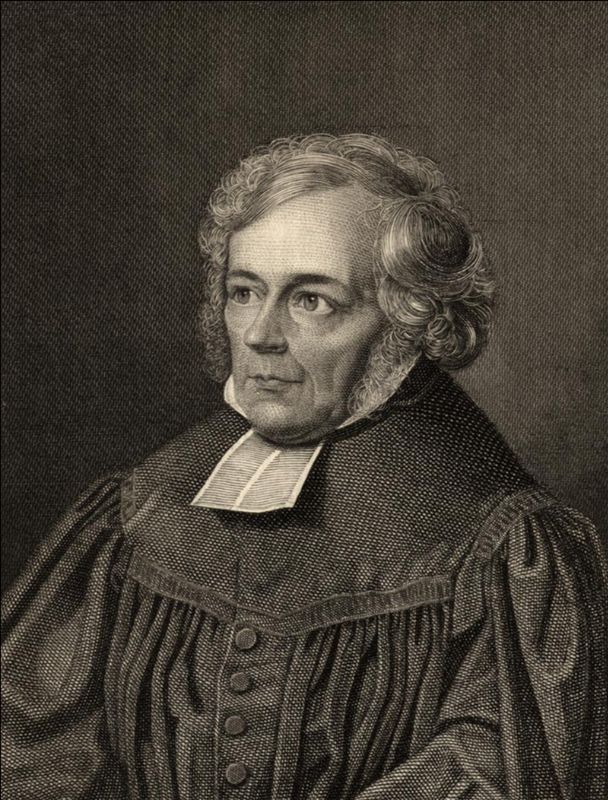
friedrich-schleiermacherRichard Crouter’s Friedrich Schleiermacher consists of a series of eleven essays, most of which were published in journals from 1980 to 2003, plus an Introduction. The unity of the collection is found, Crouter argues, in the theme of the book’s title: “Schleiermacher’s cultural location between Enlightenment and Romanticism, the appellations we give to the intellectual movements that name his cultural worlds.” (1) This does not mean that Crouter thinks one can find the essential features of Schleiermacher’s thought by generalizing about either of these movements. (7) Crouter will rather use them as backdrop, for in Schleiermacher, the lines between these two movements are “blurred”. (8) Crouter states that his approach is both historically to situate the religious debates in which Schleiermacher was enmeshed (9), and to draw out the revisions between the various editions of his major works, to show what the edits reveal, and thereby put these editorial judgments in historical profile. (10) Approaching Schleiermacher in vivo, Crouter argues, will help us both in understanding him as he was, and in understanding him as he is for us. (2) To that end, Crouter has organized his essays under three main categories, roughly: Schleiermacher’s work vis-à-vis the works of three notable figures that chronologically frame him, Schleiermacher as socially- and politically-engaged citizen, and Schleiermacher as midwife of a Modern form of Christianity. Continue reading