Peter Brown on Christianization, Part IV: The Death of the Gods and the Disenchantment of the World

One of the central features marking the transition to the modern world is disenchantment. What disenchantment entails is suggested already in the word “disenchantment” itself: the word as it was coined in German –“Entzauberung”– literally means “de-magic-ing”. For us moderns, the world, specifically nature, is no longer shot through with innate meanings and magical powers. We do not take seriously suggestions such as that the forests are filled with mischievous brownies, and that our children thus ought not play there. We would not think to eat walnuts because of a headache: the symmetry between the shape of walnuts and the shape of our brains is no longer thought to cause anything through formal affinity (except through placebo). When we come across a glade that stirs us to wonder and lofty feelings, we do not seriously, publicly think that this marks the presence of a god who dwells there — at least, we do not think this simply and without consciousness of alternative views on the glade; we do not say a god dwells there without awareness that to say so publicly is merely to advance one exotic and embattled option among others that are more common, and which are more plausible to the vast majority of our cohort. There are indeed irrational and mistaken ideas about nature floating around, but they (and we) all fall on this side of disenchantment, and so their character is different from any pre-modern notions and modes of engaging the world.

A relatively intense sense of disenchantment may mark the modern world, but the processes of disenchantment do not begin there. They begin, instead, with Christianization.  Continue reading
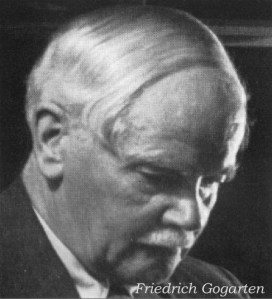
Excerpt #2 — Larry Shiner on Friedrich Gogarten on Secularism

Here is the beginning of Larry Shiner’s book on Friedrich Gogarten, a German Lutheran friedrich gogartenwho wrote during the beginning of the 20th century. I found Gogarten through a footnote in a book by another German Lutheran, Wolfhart Pannenberg, and looking at this, it is difficult to hear that Gogarten differs from Pannenberg on this topic, whether due to the historical record or to the influence Gogarten had on Pannenberg (whose take on secularity and secularization shall eventually appear here).

Gogarten’s general thesis strongly resembles elements of the disenchantment of the modern world that Charles Taylor describes. Although disenchantment is not quite the same thing as the de-divinized world that the early Christians or their successors lived in, the two are related, and the latter certainly offered part of the foundation for the former. Also similar to the above-linked post on disenchantment is the model of meaning found in Gogarten, who argues, according to Shiner, that man

universally experiences responsibility for his own destiny as the task set by his relation to the world. However feebly we may live up to it, Gogarten sees in this responsibility the Law before which we must justify ourselves today, the ultimate “ought” written into the fabric of existence.

Although the pre-Christian world can fairly be described as presenting “a mythically understood cosmos determining and securing human life by its spiritual powers”, I am uncertain as to whether the pre-Christian engagement with the world neglected to think of the world as over-against humanity. Certainly the divinity of each and all things in The Iliad militates against this? –but then this could be taken to signal that the world is not other than the subject.

If the reader discerns me to have serious reservations about this excerpt, in whole and in part, he or she would be correct. It has value insofar as it presents one take –one take– on secularization as the actualization of Christian principles. (There are other interpretations that see modernity as such an actualization, and still other takes that see the secular modern period as something autonomous, and legitimate in itself.) Enough: here is Shiner on Gogarten. Continue reading

Summaries: Peter Brown on Christianization

I

The first post introduced the historian Peter Brown and offered a summary of a lecture he gave at St. Vladimir’s Seminary on two fourth century figures, the Roman Emperor Constantine I and the bishop Eusebius of Caesarea. In it, Brown asked what the horizons of possibility were for the two men regarding Christianization. In the course of answering this, he noted:
Continue reading

Peter Berger on Protestantism and Disenchantment

1

I posted earlier about Charles Taylor’s presentation of disenchantment; here is a long excerpt on the same topic (taking a slightly different angle) by Peter Berger from his book, The Sacred Canopy:

Continue reading

Charles Taylor on Disenchantment

As perhaps the world’s premier scholar on the character of Secularism, Charles Taylor shouldn’t need an introduction. If the reader is unfamiliar with him, however, he or she should simply accept that Taylor has had a remarkable career. Following the publication of his landmark book A Secular Age, Harvard’s Belknap Press published a volume of Taylor’s essays related to the themes he earlier explored in Secular Age; the work is titled Dilemmas and Connections: Selected Essays.

Below is an abbreviated version of one of his essays from Dilemmas, titled “Disenchantment-Reenchantment” (it is Chapter 12 of Dilemmas); the bracketed numbers [xxx] indicate a page number in the original English-language hardback release. Taylor’s essay is 15 pages or so, and of course has more meat. Currently, I’ve only reduced it to about 1/4 of its original size. I plan to post more such abbreviations.

Possibly, the general thrust of Taylor’s argument may be found in the final words of the summary, below: “Despite the widespread loss of the magical world and of the metaphysics of the Great Chain of Being –even despite the widespread loss of belief in God– a strong evaluation of meaning is still possible in the modern world, even if it is a world painted by a reductive and mechanistic science, so long as this reductive language doesn’t swallow the self-perceived integrity of the evaluating agent, so that it cannot be said to truly evaluate the wonder of the world and be so motivated, by this evaluation, to respond in love.”

* Continue reading