On Might and Right

Most people plot all things with reference to wherever they are, interpret all things from the little realm they occupy. We craft entire false narratives for the meaning of the artifacts we come across through the lens of the history that is familiar to us; thus, we misinterpret the word “good” when we read it in our earliest sources, plastering over it senses that are more familiar to us, and forget that we occupy a history, a world that began, and that will (at some point) end.

Historical consciousness may be one of the characteristic features of the Secular Modern, but we are quite adept at parochial amnesia. This is a threat to what we have achieved, and obscures the principles that emerge in the reasons for the transition from the early aristocratic ideas about  “the good” to the more social and cooperative ideas about “the good”.

Without understanding the role of power in the aristocratic ideals of the earliest rulers, we cannot understand the problems that Plato addressed when he narrates Socrates’ interactions with Meno or Thrasymachus, nor can we understand Augustine of Hippo’s presentation of what lies at the heart of the civitas terrena, the earthly (rather than divine) city.

–but what is this model of power and authority, and more specifically, what was this earliest sense of “goodness”? Continue reading

Excerpt #1 — Heidegger, On Nihilism

From Martin Heidegger, Contributions to Philosophy (of the Event) transl Richard Rojcewicz & Daniela Vallega-Neu (Bloomington, IN: Indiana University Press, 2012), 109-110.

I make no claim to perfectly understand the later Heidegger (1889–1976), who, I am told by many specialists, is notoriously difficult even in German. (Contributions was written between 1936-1938, and most consider this to be after the date of his famous “turn”.) The editorial insertions in brackets are my own. Please do correct me if my reading is wrong.

I have often tried to press home the idea that Secularism is not simply something that a society does, or an idea that an individual might hold to (or might not hold to), but is the result of several unique historical events that have changed our horizons through events that were not engineered and cannot be reversed, that is the entire framework of our age, and determines every option we might take within it, even seemingly opposite ones. This is not a recipe for hopelessness, but for honesty. (Secularism too shall pass, I suggest, and it is yet to be seen what comes after it, although it will not simply reverse secularity, or a return to some supposed earlier golden age, or even a better one, much less shall it realize our pet ideology.) Heidegger, for all I can tell, seems to be saying something similar about Nihilism.

Continue reading

Stars Down to Earth

I

In Shakespeare’s Julius Caesar, Act I, Scene 2, Cassius says to Brutus concerning Caesar:

Why, man, he [Caesar] doth bestride the narrow world
Like a Colossus, and we petty men
Walk under his huge legs and peep about
To find ourselves dishonorable graves.
Men at some time are masters of their fates.
The fault, dear Brutus, is not in our stars
But in ourselves, that we are underlings.
 .

“The fault […] is not in our stars”, which stars are here connected to the “fates” of “men”. James Dunn notes, commenting on this passage, that

[…] the fear that the stars may indeed be involved has been a recurring suspicion or nightmare in all ages. And if not the stars, then supra-mundane forces of some sort or kind.
[James D.G. Dunn, The Theology of Paul the Apostle (Grand Rapids: Eerdmans, 1998), 102]
.

These “supra-mundane forces” are typically the gods, or some sort of divine/angelic (or demonic) powers. The notion of fate that accompanies the above passage from Shakespeare is, arguably, even more intense, and sounds rather Homeric, as though:

[…] No one alive has ever escaped it,
neither brave man nor coward, I tell you —
it’s born with us the day that we are born.
[Iliad, VI.488-489 (lines 582-584 of Fagles’ transl., p.212)]
.

This fate is inescapable; yet it is not always, as is often thought, inflexible. It can be steered, and even in some cases escaped temporarily, though this fate will always catch up with the individual in the end. The Greek word for “fate” (“moira”, “moros” or even “aisa”) means portion or allotment: it is the lot that is assigned to one, as C3PO whines in Star Wars: A New Hope: “We seem to be made to suffer; it’s our lot in life.” This lot is what is simply “laid on us“, and includes what are the very ambiguous “gifts” (δωρα) of the gods —e.g., the loveliness of Helen of Troy; double edged gifts, if ever there were– that would not and cannot be chosen (“no one can have them by choosing” Iliad III.66); this lot includes, at its climax, death.

I suggested that the cup of this portion is, to some degree, flexible: Achilles in the Iliad has two fates he might fill up his allotment with [IX.410 ff., Fagles, 265], though some things are not flexible, because they are beyond one’s lot or portion, and pursuing them would bring about calamity for all. The fates are, it seems, above the Olympian gods such as Zeus, though he is the one who seems to distribute the portions, the limits of men — and as we see in the Iliad VIII.70 ff., where Zeus apportions different fates to the two different armies of the war in his “golden scale”, and in the Iliad XVI.400-550. [Fagles, 427], he can override the fates or portions of men, though the cost could be great, and would bring great turmoil and chaos even among the gods.

The historical-natural-cosmic and the theological are here one and the same. Here, there are no elemental powers that are not in some sense divine, and the difference between magic and religion, or between divination and naturalistic predictions, is unrecognized, moot. Continue reading

Dating Conventions

There is a restaurant down the street from where I live, in the next town over, called “Zaftigs”. On the sign for this restaurant, so small beneath the “a” that one might not see it, there is noted the year in which it was established: “5757”.

0303161735

Sorry, Sci-Fi fans: Zaftigs was not established 3,741 years in the future.

This is not a joke. Zaftigs is in Brookline, which boasts a large Jewish population (there are three synagogues within a minute’s drive of it; it will thus come as no surprise that “Zaftig” is apparently Yiddish for “juicy”). “5757” is a dating convention using the Jewish calendar, which takes its beginnings not from an event within history, but from the alleged date for the creation of the world (“A.M.” or “Anno Mundi” is the Latin name for this calendar, meaning “Year of the World”). “5757” could be either 1996 or 1997 on the American public calendar, because the Jewish calendar does not begin on January 1st — even we in the English-speaking world only settled on January 1st relatively recently, transitioning the year’s beginning from the more traditional March 25th, the Feast of the Annunciation (of the Archangel Gabriel to the Virgin Mary).

So what is our public calendar? Continue reading

A Preliminary Synopsis of the Life of Thomas Müntzer (Occasionally Updated)

It has become a truism that history is written by the victors, and the case of Thomas Müntzer (died 1525) would not falsify this. During and after his lifetime he had acquired such high-caliber opponents as the iconic religious reformer Martin Luther, to say nothing of the secular princes of Saxony. Müntzer (also spelled Münzer, or Müncer, or even other ways, meaning “miner”) was thus largely remembered through the eyes of his opponents, until his literary remains were rediscovered in the 19th century. These remains cover a limited stretch of his life, however: his “extant, authentic writings and correspondence from the scant ten years between 1516 and 1525, along with scattered reports about him, are not sufficient sources for writing a genuine biography.” [Seebass, 338[1]] Indeed, “Little can be told with certainty about Müntzer before 1517”. [Gritsch, 1[2]]

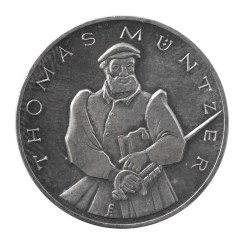
Müntzer Medaille 1976

An East German coin

This uncertainty has not prevented various factions from advancing their claims for or against him, however. Frederick Engels and Marxist historians have claimed him as a forerunner of revolution, championing the working class against the oppression of the landlords (he became a hero in East Germany‘s Socialist national narrative). Martin Luther and Lutheran historians have despised him as a rebel and revolutionary, because of his role in the German Peasant’s War above all, and a fanatic, because of his propounding the necessity of a mystical and activist spirituality which required spiritual purification through suffering and divine abandonment, for which a special illumination distinct from the biblical text was required — as opposed to the sufficiency of a trusting response to the divine promise in the divine Word as it was set forth in proper preaching and rites of worship, per Martin Luther and the Wittenberg reformers (Müntzer thought that the text of the Bible was dead “Babel” without this illumination and transformation through the Spirit, just as Calvin would in a few short years say that the Bible was not the Word by the act of preaching and the rites of worship, as Luther taught, but was a deposit of divine teaching, requiring the additional illumination of the Spirit to properly interpret it). Anabaptists and other contemporary groups stemming from the so-called Radical wing of the Reformation have a conflicted stance toward him, disapproving of his use of the sword, while looking favorably upon many elements of his theology and spirituality, especially his emphasis on a faith that bears fruit in deeds and on the separation of the chosen people of God from “the world.” (Most current works on him attempt to temper or remove any ideological excesses of previous scholarship, even if they incline one way or another.)

Another East German coin, marking what was presumed to be the 500th anniversary of Müntzer's birth.

Another East German coin, marking what was presumed to be the 500th anniversary of Müntzer’s birth.

Psychologically, it is very easy to drape upon his words and deeds the most noble or else the basest motives, making chastity of psychological conjecture important for lack of certainty. As a final flourish of uncertainty, we don’t even know what he looked like — the earliest portrait of him was made long after his execution (not that a portrait would be an enormous help in reconstructing his life and motives). Yet despite the lack of certainty on nearly every level, we can say from what we do know that his life was at least iconic for many threads of the modern world, as the war over his legacy illustrates.

Continue reading